

A dark, dusty element often prompts an early replacement. But appearance is a poor guide to the remaining life of a truck or machinery air filter. An element may look dirty and still be within its service limit. Another may look relatively clean but have a damaged seal.
For replaceable dry-type engine air filters, follow the equipment manufacturer’s maintenance requirements and restriction limits. Check the element and sealing surfaces during the specified service procedure.
The guidance below does not apply to oil-bath air cleaners or washable, oiled filters.
What a Layer of Dust Tells You
Dust on the dirty side of an air filter is expected. It shows that the element has been collecting contamination, but it does not tell you how much useful life remains.
In conventional cellulose media, a developing dust layer can improve particle capture. It also makes airflow through the element more difficult. Eventually, the restriction reaches the equipment’s service limit.
This is why neither “replace it as soon as it looks dirty” nor “a dirty filter works better, so leave it in” is a reliable maintenance rule.
The filter must keep contamination out while allowing the engine to receive the airflow it requires.
Read Restriction Against the Equipment Specification
A restriction indicator or gauge helps determine when resistance in the intake system has reached the service limit.
Use the limit and measurement procedure for the particular engine and air-cleaner installation. A reading suitable for one machine should not be applied to another without checking.
The operating conditions matter too. A reading taken at idle cannot be treated as equivalent to one taken under the specified load. Some indicators retain the highest restriction reached; others display the current reading. Check which type is fitted and how it should be read.
After maintenance, reset the indicator as instructed. Simply resetting a warning without addressing its cause does not resolve the problem.
Also check for any mandatory time-based replacement requirement in the equipment manual. Restriction monitoring does not override those instructions.
A Low Reading Does Not Rule Out Damage or Leakage
A restriction indicator measures resistance to airflow. It does not directly detect dust passing through a tear or around a poor seal.
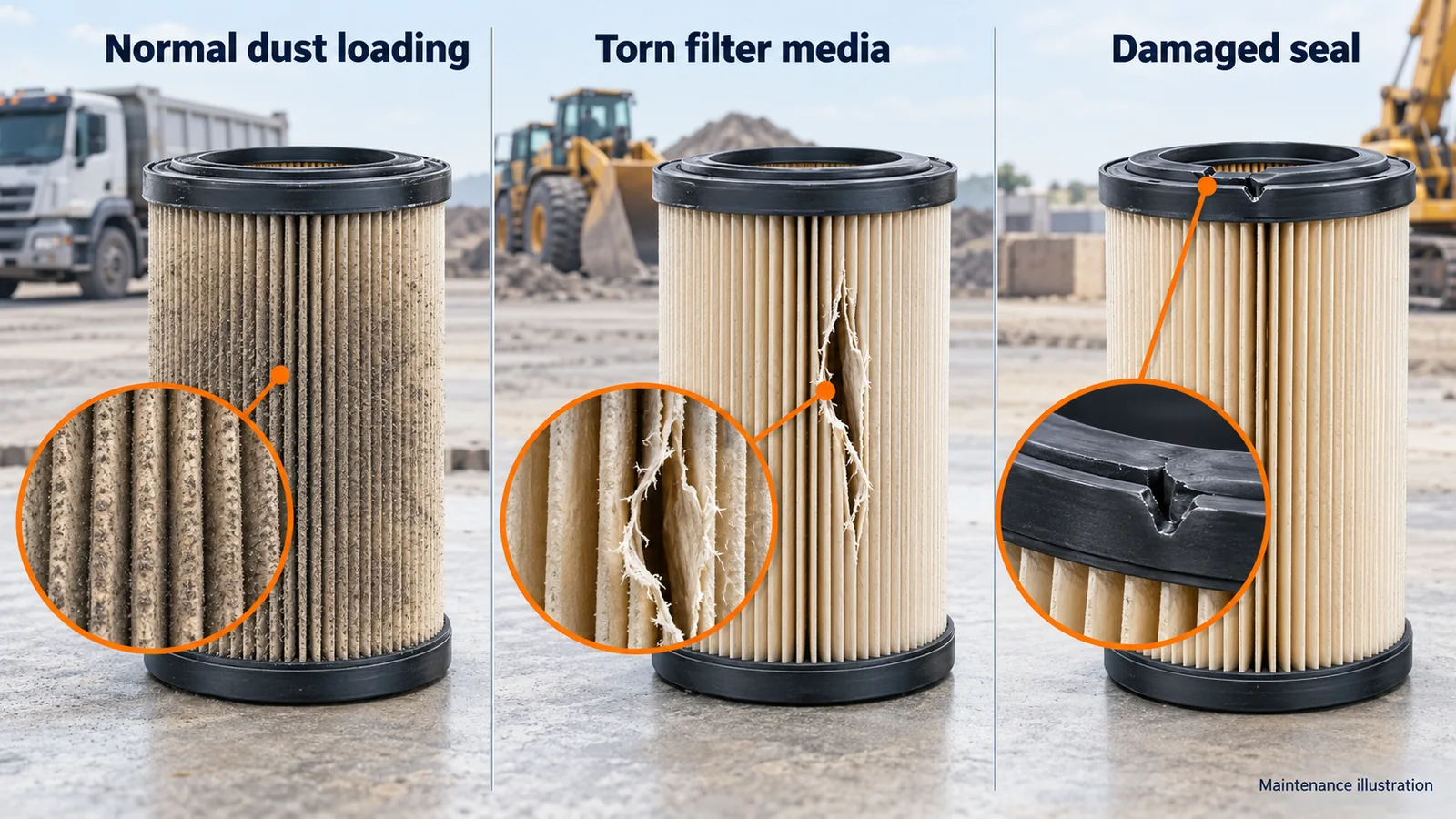
During scheduled servicing, check the element, sealing surfaces and accessible clean-air path. Do not reinstall a filter with torn media, distorted components or a damaged seal.
Dust found beyond the filtration barrier needs investigation. Check whether the element was seated correctly, whether the housing is intact and whether downstream intake connections are secure. Replacing the element alone may leave the original leak unresolved.
Treat normal dust loading and damage as separate issues. Loading affects service life; a damaged element or leaking connection can compromise engine protection before restriction reaches its limit.
Avoid Unnecessary Removal
Pulling the filter out repeatedly to inspect its colour adds handling without necessarily providing useful information.
Each removal can disturb the seal, expose the clean-air outlet to contamination or introduce an installation error. Follow the prescribed inspection schedule rather than opening the housing whenever the element looks dusty.
When replacement is due, have the correct part ready before removing the old one. Protect the clean-air opening as directed and minimise the time the housing remains open.
Do not knock the element against a hard surface to shake dust loose. Whether an element may be cleaned—and by which method—depends on the instructions for that filter and application.
The Safety Element Has Its Own Service Requirements
Some heavy-duty air cleaners contain a smaller safety element inside or downstream of the primary element.
It protects the clean-air outlet during primary-element servicing and provides backup if the primary element is damaged or incorrectly installed. It is not intended to carry the normal dust load on its own.
Do not clean the safety element or run the engine with only that element installed.
During routine primary-element servicing, leave the safety element in place unless its own replacement procedure requires removal.
Follow the equipment’s replacement instructions rather than automatically changing both elements together. If abnormal dust loading appears on the safety element, replace it as required and investigate how contamination passed the primary barrier. See the primary vs safety air-filter guide for the distinction between these two elements.
Record Why the Filter Was Changed
A useful maintenance record includes the equipment identification, filter reference, operating hours or mileage, restriction reading and reason for replacement.
“Looked dirty” offers little help when the next filter is removed. “Reached the specified restriction limit,” “damaged gasket” or “dust found downstream” gives the workshop something specific to track.
If filter life seems unusually short, send those records and photos of the element and housing to the supplier. Confirm the original reference and application before considering an alternative. A similar-sized element is not automatically suitable or longer-lasting. When dimensions must be confirmed, use the air-filter measurement guide.
For air-filter enquiries to JINGUAN, include the equipment or engine model, existing filter number, operating environment and any available restriction readings. Specify whether you need the primary element, safety element or both.