
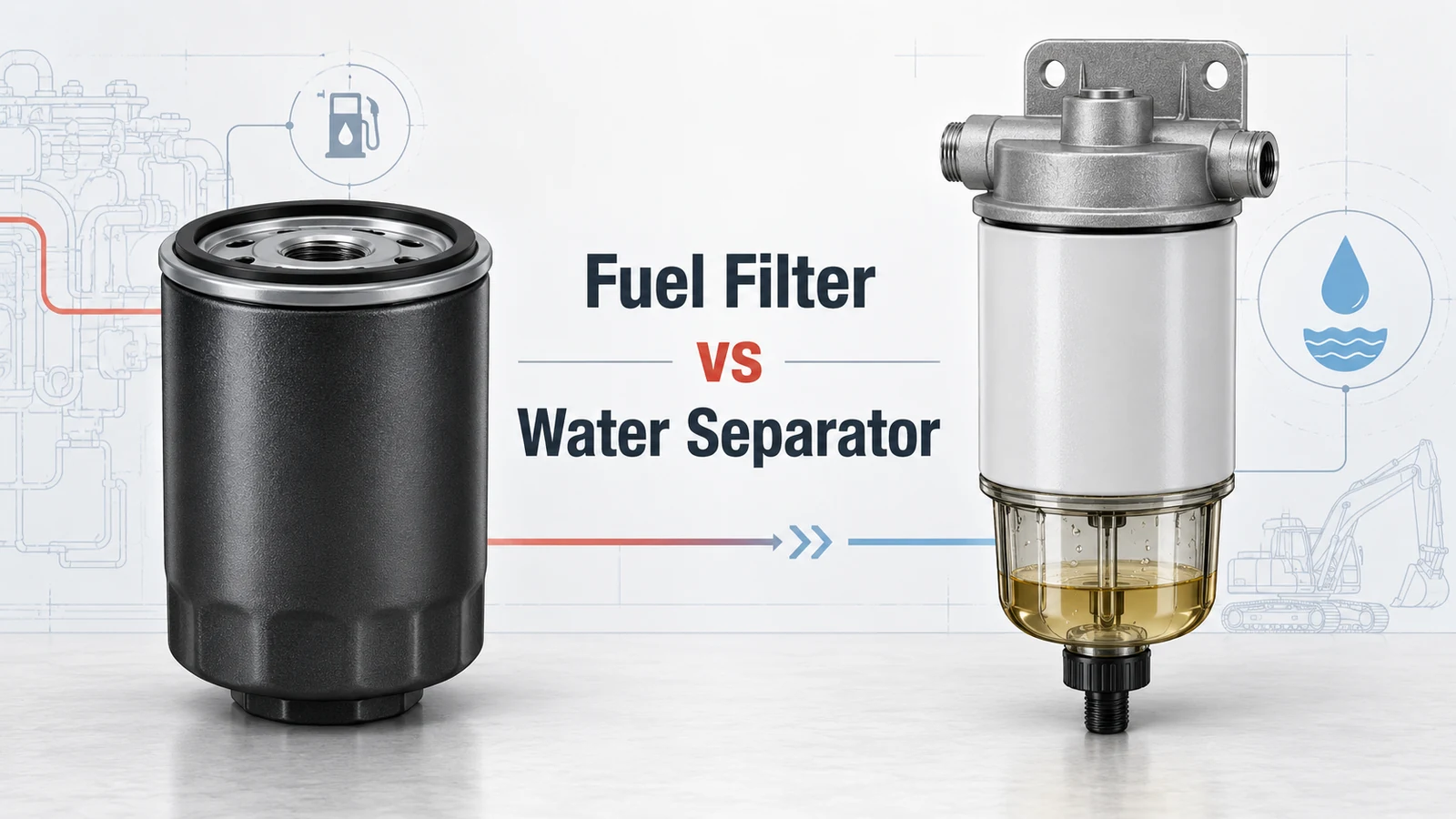
A filter that removes dirt does not automatically provide the water separation a diesel engine requires.
Fuel filters and fuel water separators are closely related. In many diesel systems, a water separator also filters solid particles. However, particle-removal efficiency and water-separation performance are different specifications and should be checked separately.
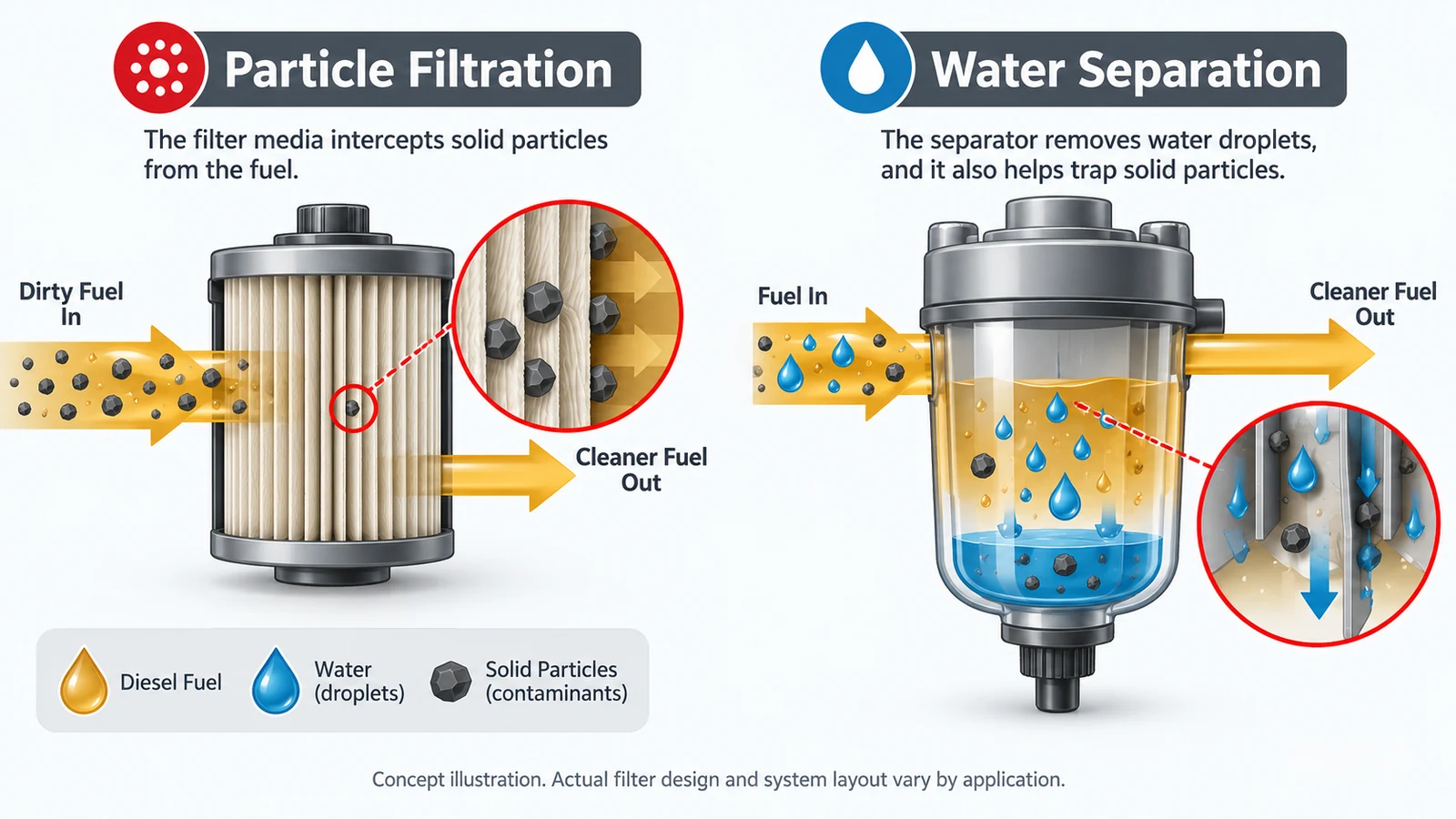
For distributors, importers and equipment-parts buyers, the important question is not simply what the product is called:
Does the replacement provide the functions required at that position in the fuel system?
1. Understand the Job of Each Filter
In many two-stage diesel fuel systems, the primary filter is located before the fuel transfer pump. It needs low flow restriction and commonly combines particle filtration with water separation.
The secondary filter, located downstream of the transfer pump, provides finer particle filtration to protect sensitive injection components. It also operates under different pressure conditions.
These filters work together. “Primary” does not mean less important, and “secondary” does not mean optional.
The exact arrangement depends on the engine. Confirm the original filter position and equipment specification before selecting a replacement, rather than assuming every diesel system uses the same layout. Buyers can review the current fuel filter and water separator range as a starting point for product identification.
2. Why Water Separation Matters
Solid contamination is not the only threat in diesel fuel. Water can contribute to corrosion, wear and damage within the fuel system. Free water can also freeze in cold conditions and obstruct fuel flow.
Free water consists of separated droplets that can collect at the bottom of a tank or separator.
Emulsified water consists of much smaller droplets suspended in the fuel, making separation more challenging. Fuel composition and additives can also affect separation performance.
When comparing water separators, ask whether the stated performance relates to free water or emulsified water, and under which test conditions.
A percentage without that context is not enough to make a reliable comparison.
3. A Micron Rating Does Not Tell the Whole Story
A specification such as “10 micron” describes a particle-size reference. It does not, by itself, tell you how efficiently the filter removes particles of that size—and it does not describe water-separation performance.
Consider an illustrative comparison, not a rating for any particular product:
One filter removes 95% of particles at a specified size. Another removes 99% under the same test conditions.
Both might be advertised using the same micron figure, but their performance is not identical.
When requesting technical information, ask for the particle size, removal efficiency and test method together.
For a fuel water separator, request the water-separation specification separately. Do not assume that a finer particle rating automatically means better water removal.
4. Is a Finer Filter Always Better?
Not necessarily.
Filter selection must balance contamination removal with flow restriction and service requirements. A finer replacement that is not suitable for the system can increase pressure drop or shorten service life.
Restriction depends on the filter construction, flow rate, fuel temperature and viscosity. A filter should therefore be selected against the engine’s requirements—not simply by choosing the smallest micron number available.
Ask the supplier to confirm the required flow capacity and relevant operating-pressure limits for the exact application.
The objective is to maintain the fuel system’s intended protection and fuel supply, not to “upgrade” one specification while overlooking the others.
5. Matching Dimensions Does Not Prove Interchangeability
Two filters can have similar dimensions yet differ in sealing arrangement, flow performance or compatibility with the original assembly.
For replacements, check more than the outside diameter and overall height. The thread, gasket or O-ring location, cartridge interfaces and associated components must also match.
Where applicable, confirm:
- Whether the original water-collection bowl and drain can be reused.
- Whether the water-in-fuel sensor fits the replacement.
- Which seals and accessories are included in the supplied package.
Some assemblies require the sensor to be transferred during replacement. That makes the sensor connection and its seal part of the compatibility check—not an afterthought.
For purchasing, make these details explicit in the quotation. “Equivalent replacement” should identify what is equivalent, not leave the buyer to discover differences during installation.
6. Draining Water and Replacing the Filter Are Different Tasks
A separator collects removed water so it can be drained according to the equipment manufacturer’s instructions.
Draining that water does not remove the solid contamination already held in the filter media. Filter replacement must still follow the engine or equipment manufacturer’s maintenance requirements.
Repeated water accumulation also deserves investigation beyond the filter. Water may enter through contaminated deliveries, condensation, leaks or poorly maintained storage arrangements. Replacing the element alone does not address those sources. If a warning appears after service, use this fuel-filter replacement troubleshooting guide to separate installation, sensor and supply-system checks.
7. What Should Buyers Include in an Inquiry?
Use the following information to make supplier quotations easier to compare.
| Information | What to provide or confirm |
|---|---|
| Product identification | Original part number, OEM reference and available photos |
| Application | Vehicle or equipment model, engine and relevant variant |
| Installation position | Primary, secondary or integrated filter assembly |
| Required performance | Approved particle-filtration and water-separation requirements |
| Operating conditions | Fuel type, required flow and relevant temperature or pressure limits |
| Assembly compatibility | Thread, dimensions, seals, bowl, drain and sensor connections |
| Supply scope | Element only, spin-on filter, service kit or complete assembly |
Where information is missing, ask the supplier to identify what still needs confirmation. Do not fill the gap with an assumed cross-reference or a similar-looking product.
Choose by Function, Not Just by Name
A fuel water separator may also be a particle filter, but that does not make every fuel filter a suitable substitute.
Before approving a replacement, confirm its application, filtration function, operating requirements and assembly compatibility. Compare prices only after those requirements are aligned.
For a fuel-filter inquiry to JINGUAN, send the original reference, equipment details and photos of the existing filter and its connections. Include any special fuel or operating requirements so the proposed replacement can be checked against the application. You can send these details through the RFQ form.
Match the original requirements first. Compare the replacement price second.