
Fleetguard’s published LF670 specification lists “Pressure Valve: No.” An LF670 should therefore not be rejected simply because an internal pressure-operated bypass valve is not visible.
That does not establish how bypass protection is provided on a particular engine. The filter head and lubrication circuit must be checked against the engine’s service information.
It also does not mean that LF777 takes over the main oil flow when LF670 becomes restricted. In the separate-filter arrangements described in Cummins service literature, LF670 and LF777 perform different filtration jobs.
LF670 vs. LF777: The Main Differences
LF670 is identified as the full-flow oil filter in the relevant Cummins service arrangements. It filters the main lubricating-oil flow during normal operation.
LF777 is a bypass oil filter. It filters a smaller portion of the oil through a separate branch. It supplements the full-flow system rather than replacing it.
Their published dimensions also show why appearance alone is not enough:
| Published specification | LF670 | LF777 |
|---|---|---|
| Filtration role in the cited Cummins arrangements | Full-flow filter | Bypass filter |
| Height | 249.20 mm | 249.20 mm |
| Largest outside diameter | 120.27 mm | 116.08 mm |
| Mounting thread | 1 1/2-12 UNF 2B | 1 3/8-16 UNF 2B |
| Fleetguard “Pressure Valve” field | No | No |
The two filters have the same published height, but different threads and outside diameters. They are not interchangeable filters for the same mounting position.
The dimensions and valve fields above describe the Fleetguard reference products, not test results or manufacturing specifications for a JINGUAN replacement.
A Bypass Filter Is Not a Bypass Valve
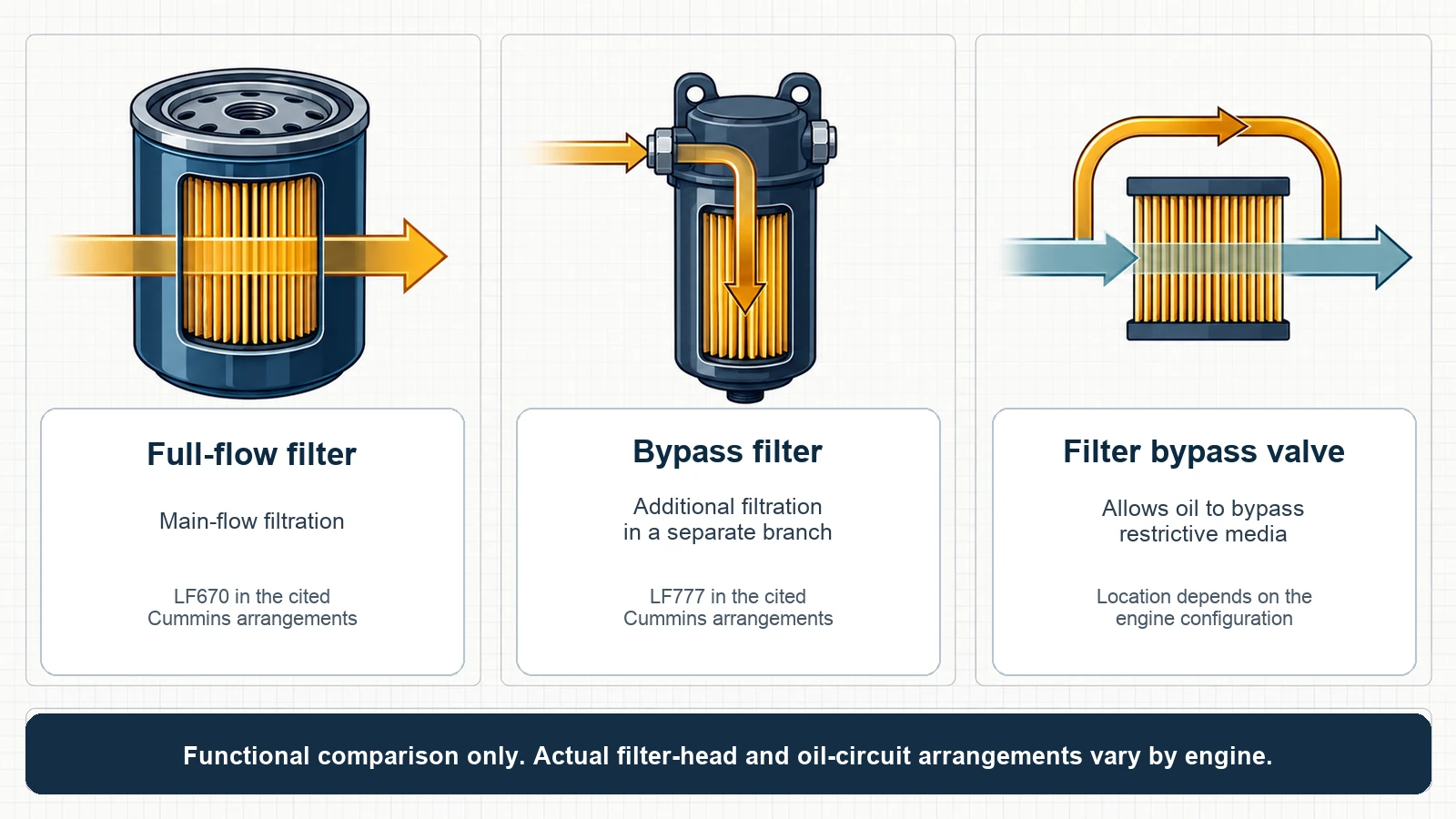
The similar names cause much of the confusion.
Bypass filtration still sends oil through filter media. A separate filter, such as LF777 in the applicable arrangement, treats part of the circulating oil.
A filter bypass valve allows oil to go around restricted filter media. It opens at the specified pressure difference to help maintain oil supply.
Depending on the engine design, that valve may be incorporated into a filter or located in an engine-side filter head or oil passage. Its location and operating specification must be confirmed for the actual installation.
LF777 is not the valve inside LF670, and it is not a substitute for the main full-flow filter.
Why the Word “Bypass” in a Catalogue Needs Context
Fleetguard’s current LF670 product description mentions full-flow and bypass filtration, while its specification table separately states “Pressure Valve: No.”
Those statements should not be combined into an assumption that LF670 contains an internal pressure-relief bypass valve. A description of filtration and a statement about a valve are different pieces of information.
For purchasing, use the product’s technical specifications together with the engine’s service requirements. If the proposed replacement differs from those requirements, ask the supplier to explain the difference before approving it.
What Happens When Restriction Increases?
A filter bypass valve responds to the pressure difference across the filter element—not simply the oil pressure shown on the dashboard.
Cold, viscous oil can produce enough resistance for the valve to open temporarily. Heavy contamination loading can also increase restriction.
Where the system is designed to provide this bypass path, oil can flow around the restrictive media to help maintain lubrication. That oil is not being filtered by the element it bypasses.
A temporary cold-start bypass event is not automatically a filter failure. Persistent excessive restriction, however, requires investigation.
Check the lubricant specification, operating conditions, service history and the relevant engine diagnostic instructions. If the element is loaded beyond its service limit, replace it as required. Do not extend maintenance intervals simply because a protective bypass path exists.
The oil-pressure gauge alone cannot confirm whether the filter bypass valve is open.
Are LF670 and LF777 Always Used Together?
No. The required filter arrangement depends on the engine configuration.
For example, Cummins’ published maintenance guide notes that some K19 engines use combination filters, while others use separate full-flow and bypass filters. The guide lists LF670 and LF777 for the separate-filter arrangement.
This is an application example, not permission to convert one system into another. Finding “K19” on a machine—or finding one LF670 installed—is not enough to determine the complete filter set.
Confirm the engine serial number, CPL where available, current filter references and installed filter-head arrangement. If the assembly has been changed, identify what is fitted now as well as the original specification.
The filtration arrangement and the location of its protective bypass valve are separate checks. A combination filter or a separate bypass filter does not, by its name alone, establish where the pressure-operated valve is located.
What to Confirm Before Ordering an LF670 Replacement
Provide the supplier with:
- The engine manufacturer, model, serial number and CPL where available.
- The existing filter references and OE numbers, including any second oil filter.
- Clear photographs of the filter labels and mounting heads.
- Quantities, destination and any specific maintenance requirements.
Ask for confirmation of the mounting thread, gasket dimensions, overall size and suitability for the required filtration position. If valve configuration is in question, resolve it using the engine’s service information rather than a photograph of the filter alone.
For currently published product identification details, see our LF670 oil filter product page.
For an LF670 replacement quotation, send the information above to JINGUAN. We will review the requested reference and identify any details still needed before confirming compatibility and supply.
Fleetguard and Cummins names and part numbers are used for identification and technical comparison only. They do not imply original-equipment affiliation or endorsement.