
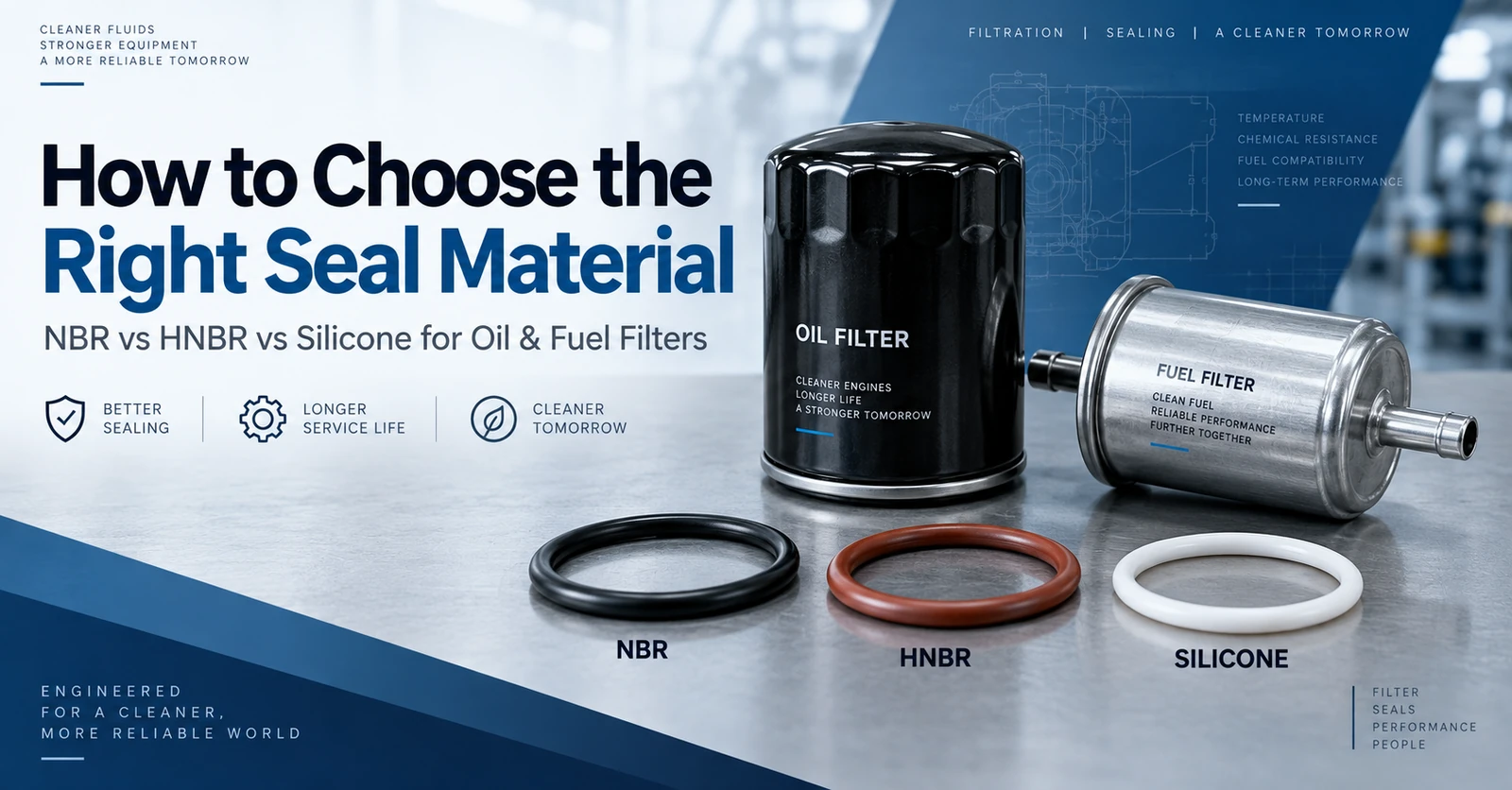
When comparing oil filters and fuel filters, buyers often focus on the part number, dimensions, filter media and price.
The rubber seal deserves attention too. Sealing materials need to suit the intended application—not simply fit the available space. Filter manufacturers likewise specify sealing materials according to the application. (MANN-FILTER)
But choosing a seal is not a matter of buying the most expensive rubber.
For many compatible oil and diesel applications, a properly specified NBR compound can meet the requirement without an unnecessary material upgrade. More demanding conditions may justify HNBR or another material, but the reason should be clear: temperature, fluid compatibility, durability or a specific equipment requirement. (Freudenberg Sealing Technologies)
The purchasing question is not “Which rubber sounds better?” It is “Which seal has been specified and verified for this application?”
First, Identify Which Seal You Are Comparing
For both spin-on filters and cartridge-type filters, including those commonly called eco filter elements, make the sealing component explicit in the inquiry.
Are you discussing the filter mounting gasket, the housing-cover O-ring, or another seal within the assembly?
For a cartridge replacement, also confirm which replacement seals are included in the package. Do not assume that every seal needed during servicing is attached to the filter element.
A useful quotation should identify the exact filter reference and sealing component—not simply state “with rubber ring.”
NBR: A Practical Choice When the Application Allows It
NBR stands for nitrile butadiene rubber. It is widely used for oil- and fuel-resistant seals and offers useful mechanical properties for many sealing applications. (Freudenberg Sealing Technologies)
NBR should not automatically be described as “low-quality rubber.”
However, NBR is a material family, not one fixed specification. Its acrylonitrile content affects the balance between oil resistance and low-temperature flexibility. A formulation designed for better resistance to petroleum fluids may not offer the same cold flexibility as a low-temperature formulation. (ERIKS)
For purchasing decisions, this means:
A validated NBR seal is a sensible option when it meets the required fluid, temperature and service conditions.
There is little reason to pay for a different material simply because its name sounds more advanced. Equally, a standard NBR seal should not replace a higher-performance specification merely to reduce the filter price.
Start with the equipment requirement, then compare compliant options.
HNBR: An Upgrade for Specific Demands
HNBR is hydrogenated nitrile butadiene rubber.
Hydrogenation improves resistance to heat and oxidative aging compared with conventional NBR. HNBR also offers strong mechanical properties, making it relevant where temperature and durability requirements are more demanding. Freudenberg identifies it as a more expensive material used where higher temperatures or mechanical strength are required. (Freudenberg Sealing Technologies)
HNBR also has resistance to petroleum-based lubricating oils and diesel fuel, although the exact compound and operating conditions still need verification. (ERIKS)
Before accepting an HNBR price premium, ask the supplier:
What requirement does this HNBR compound meet that the proposed NBR compound does not?
The answer should refer to a specification or test result—not simply “better quality.”
Also, HNBR does not automatically mean extreme-cold performance. Published HNBR compound ratings differ, so buyers must check the particular grade rather than rely on the abbreviation alone. (ERIKS)
Silicone: Wide Temperature Capability, but Not Universal Compatibility
Silicone rubber, commonly designated VMQ, is known for its high-temperature resistance and flexibility at low temperatures. However, it generally has lower tear and abrasion resistance than many conventional sealing rubbers. (ERIKS)
For fuel filters, an additional limitation is critical:
Ordinary VMQ silicone is generally unsuitable for direct contact with hydrocarbon fuels.
A seal’s ability to remain flexible in cold conditions does not establish its resistance to diesel or gasoline. Selecting silicone solely because it has an impressive temperature range can therefore create a compatibility problem. (Freudenberg Sealing Technologies)
Do not confuse VMQ with FVMQ, or fluorosilicone. They are different material families. Trelleborg identifies FVMQ among materials used for low-temperature fuel-system seals. This is not permission to substitute it without checking the application. (Trelleborg Sealing Solutions)
For selected oil-contact applications, silicone may be suitable when the specific compound, lubricant and seal design have been validated. That does not make it a universal replacement for NBR or HNBR. (Parker O-Ring Handbook)
Temperature Ratings: Useful References, Not Filter Guarantees
Material guides provide broad temperature ranges, but these are not interchangeable with the operating rating of a finished filter.
For example, Freudenberg publishes the following general material ranges:
| Material | General reference range | What buyers must remember |
|---|---|---|
| NBR | Approximately −30°C to +100°C | Cold flexibility and fluid resistance depend on formulation. (Source) |
| HNBR | Approximately −40°C to +140°C | The exact compound must meet the specified conditions. (Source) |
| VMQ silicone | Approximately −60°C to +200°C | A wide temperature range does not establish fuel compatibility. (Source) |
These are illustrative material references, not guaranteed service limits for every gasket or filter. Temperature capability must be assessed together with compatible media and the actual operating conditions. (Trelleborg Sealing Solutions)
For cold-weather applications, specify the cold-start requirement
For a customer buying filters for Russia or another cold-weather market, “suitable for cold climates” is not a complete specification.
For example, if equipment must start after standing overnight at −40°C, put that requirement in the inquiry. Ask for evidence that the proposed compound and seal design can perform under those conditions.
Do not assume that any NBR is unsuitable—or that any HNBR is suitable. NBR formulations vary significantly in their balance of cold flexibility and resistance to petroleum fluids. (ERIKS)
For hot-weather applications, specify the operating condition
A destination country alone does not define the temperature at the seal.
Ask for the expected continuous operating temperature, any short-duration peaks, and the fluid contacting the rubber. A material rating established in hot air should not be treated as an identical rating in oil or fuel. (Trelleborg Sealing Solutions)
Material Type and Seal Quality Are Different Questions
Specifying HNBR or silicone does not remove the need to check manufacturing quality.
Compound formulation, hardness, dimensions, molding quality and compression behavior all affect sealing performance. Two rings carrying the same material abbreviation are not necessarily equivalent. (Parker O-Ring Handbook)
One useful property is compression set: the permanent deformation remaining after a seal has been compressed under defined conditions. Results should be compared using consistent test temperatures, durations and methods; a percentage without its test conditions can be misleading. (Parker O-Ring Handbook)
When comparing suppliers, request the exact compound identification and relevant verification records. Where the application requires it, discuss fluid-exposure testing, low-temperature performance and leakage testing of the assembled filter.
The aim is to verify the supplied component—not just approve a material name.
What to Include in an Oil or Fuel Filter Seal Inquiry
To make quotations comparable, provide four groups of information:
- Filter and application: OEM or reference number, engine or equipment, spin-on or cartridge construction, and the specific sealing location.
- Operating conditions: Oil or fuel type, any relevant blend or additive information, minimum cold-start temperature, and maximum operating temperature.
- Seal specification: Drawing or dimensions, profile, material and hardness requirements where available, and any OEM specification.
- Supply and verification: Which replacement seals must be included, what technical evidence is required, and whether samples need approval before bulk ordering.
Avoid asking only for “the best rubber.” Ask suppliers to quote against the same requirements and explain any proposed material change.
Choose the Required Performance, Not the Highest Price
A more expensive seal should solve a defined problem.
If an approved NBR compound already meets the application, upgrading solely for a premium label adds cost without establishing an additional benefit. If the operating conditions exceed that specification, choosing the cheapest option is not a saving either.
The right decision is to match the fluid, temperature, sealing design and verified performance, then compare price.
For an oil or fuel filter inquiry with JG Auto Filter, send the part number, equipment application and any special temperature or sealing requirements. Request confirmation of the seal specification for that exact reference before approving the order.
Specify the conditions first. Choose the material second.