
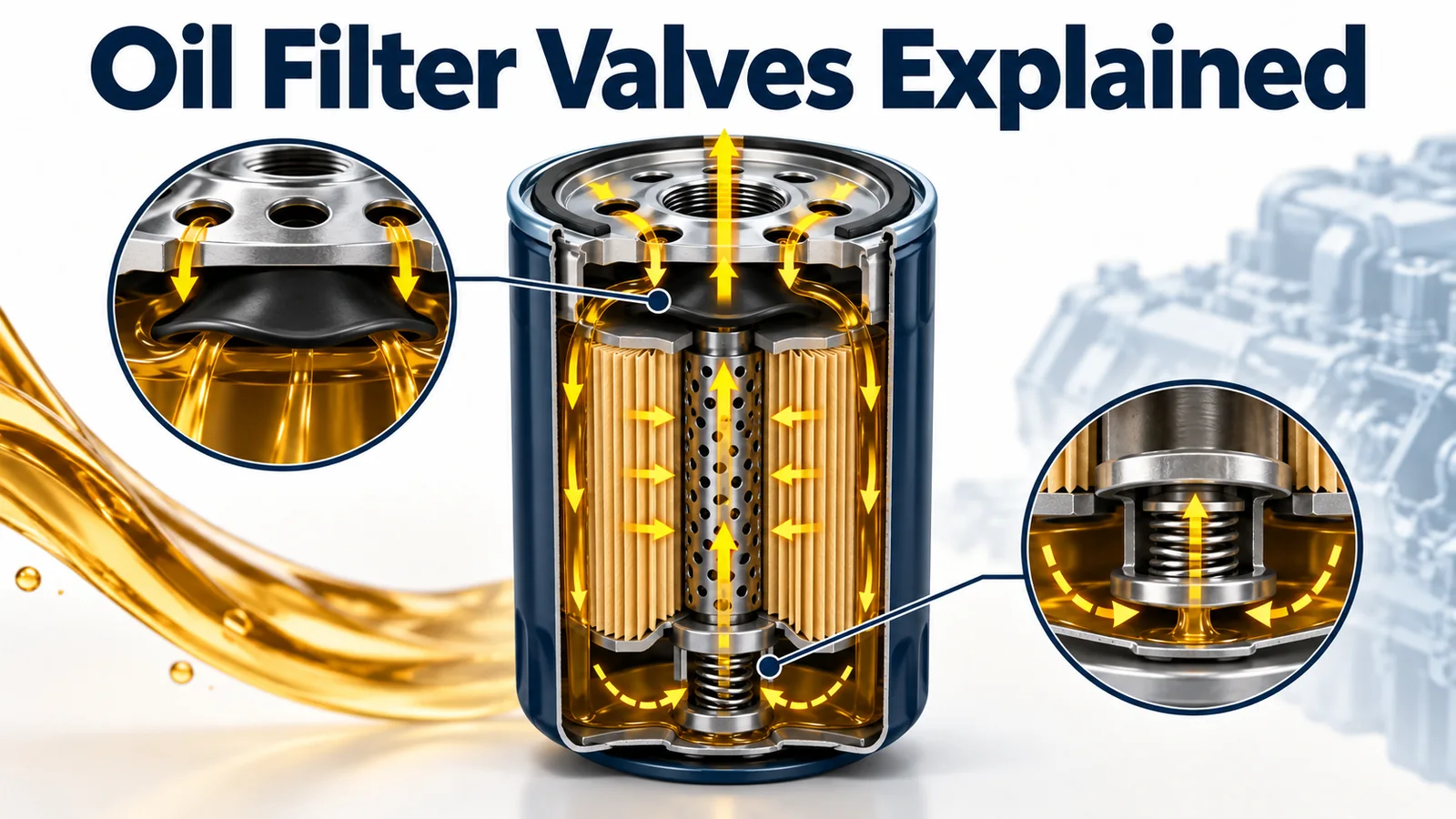
Two oil filters may have the same thread, similar dimensions and a matching gasket. That does not necessarily make them interchangeable.
The difference may be inside: one contains an anti-drainback valve, another relies on the engine’s arrangement, and their bypass-valve specifications may differ.
For buyers sourcing replacement oil filters for trucks, construction machinery and diesel engines, these details belong in the compatibility check—not just in a cutaway photograph.
What Does the Bypass Valve Do?
During normal filtration, oil passes through the filter media before continuing through the lubrication system.
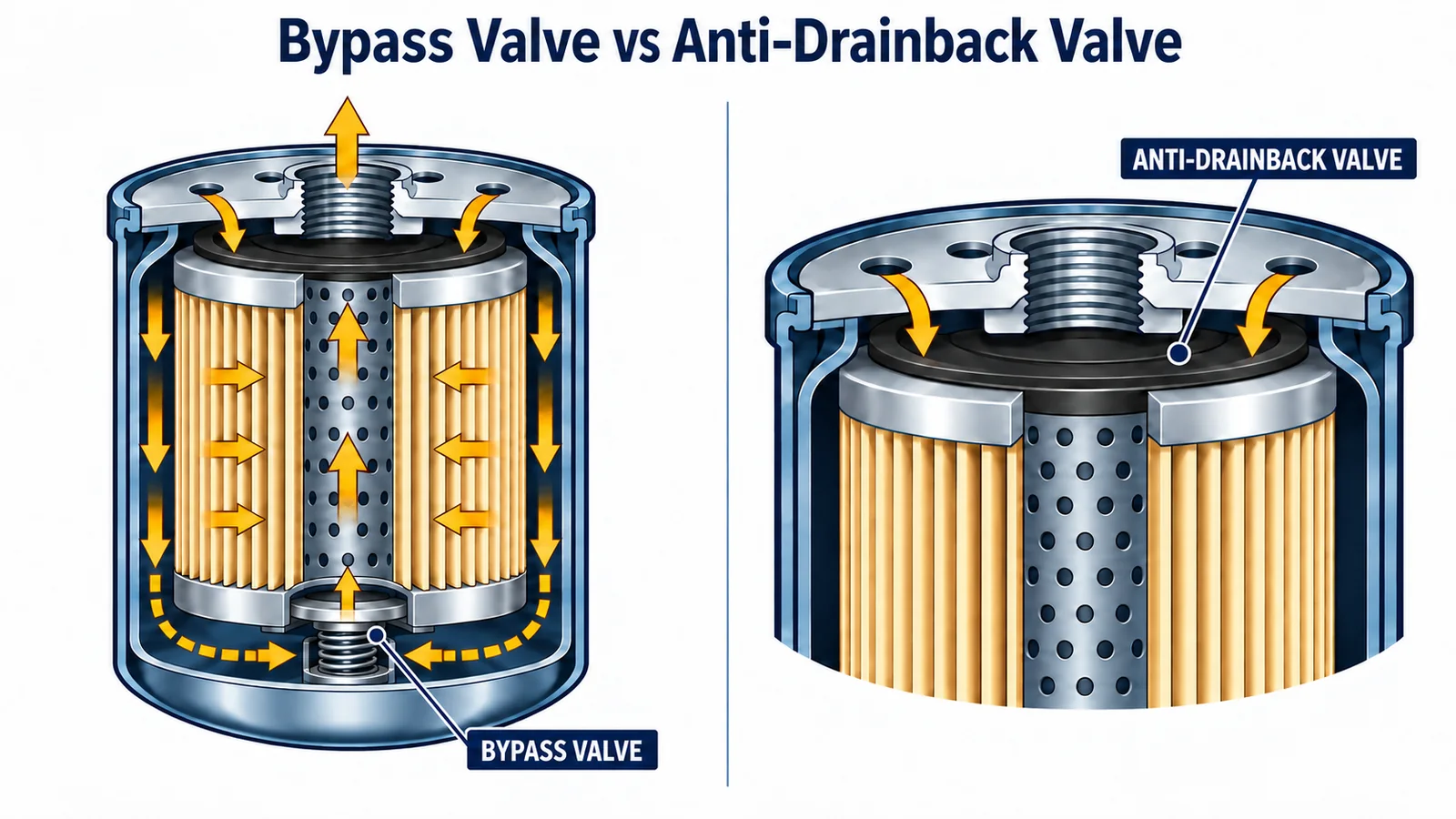
If resistance becomes excessive, the bypass valve opens an alternative route around the media. This helps maintain oil supply when forcing all the oil through the element would restrict flow too much.
Two common situations are cold starts, when oil is more viscous, and heavy contamination loading, when the element has become restrictive.
The oil taking the bypass route is not filtered by that element. The valve therefore provides protection against insufficient lubrication; it does not make filtration unnecessary or justify extending replacement intervals.
A bypass valve is there to preserve oil flow when needed, not to improve filtration efficiency.
Bypass Opening Pressure: Check the Pressure Difference
A filter bypass valve responds to the pressure difference across the filter element, not simply the pressure displayed on the engine’s oil-pressure gauge.
For example, if pressure before the media is 5 bar and pressure after it is 4 bar, the difference is 1 bar.
These numbers illustrate the calculation only. They are not a recommended valve setting.
When a supplier specifies bypass opening pressure, ask for the relevant range, units and test conditions. A statement such as “with bypass valve” confirms only that a valve is present—not that its operating characteristics suit your engine.
A higher opening pressure is not automatically better, and a lower setting is not automatically safer. The valve must operate as required by the original lubrication-system design.
Do not approve a substitute simply because it has the same mounting thread and a spring-loaded valve inside.
What Does the Anti-Drainback Valve Do?
The anti-drainback valve serves a different purpose: it helps keep oil from draining back out of the filter after the engine stops.
In many spin-on filters, it is an elastomer membrane positioned behind the inlet holes in the base plate. Oil pressure allows incoming oil to pass during operation. When the engine stops, the membrane closes against those openings to restrict reverse flow.
Retaining oil helps reduce the amount that needs to refill at the next start. Whether this function is required within the filter depends on the mounting position and the engine’s oil-circuit design.
The anti-drainback valve controls reverse flow. It does not provide a substitute for the bypass valve.
Does Every Oil Filter Need Both Valves?
No—not necessarily inside the replaceable filter.
Some systems incorporate the bypass function in the filter housing or engine-side assembly. Many cartridge-filter systems retain the required valves within the permanent housing rather than replacing them with the paper element.
Anti-drainback requirements also depend on the system layout.
This means a cartridge element without a visible rubber valve is not automatically incomplete. Likewise, a spin-on filter without an internal bypass valve is not automatically defective.
The question is whether the complete installed system provides the functions required by the engine.
Before judging a filter by its internal appearance, establish where the original system places those functions. Adding a valve or selecting a different opening setting without checking the application is not a reliable upgrade.
Why Matching the Outside Is Not Enough
Height, diameter, thread and gasket dimensions are important checks. They tell you whether a filter may physically fit.
They do not establish the correct valve configuration, opening characteristics or filtration performance.
For an unfamiliar replacement, start with the original part number and exact engine application. Then ask the supplier to confirm the internal requirements alongside the dimensions. The JINGUAN oil and lube filter range can help buyers begin with the correct product family.
A cross-reference can help identify a candidate, but it should not replace application verification when technical information is missing or conflicting.
For distributors managing a large range, record these details against each part number. Avoid grouping filters as equivalent solely because their cans and threads look the same. For a broader selection checklist, see how to choose the right oil filter.
What to Confirm Before a Bulk Order
Use the following information when requesting a quotation or approving a replacement.
| Item | What to confirm |
|---|---|
| Application | Original filter reference, engine model and relevant equipment variant |
| Filter construction | Spin-on filter or cartridge element; intended housing or mounting arrangement |
| Bypass arrangement | Whether the function is provided by the filter or elsewhere in the assembly |
| Bypass specification | Required opening-pressure range, units and supporting technical information |
| Anti-drainback requirement | Whether it is required in the replacement and how that requirement is verified |
| Physical compatibility | Dimensions, thread, gasket or O-ring location, and cartridge interfaces |
For first orders, ask which specifications are confirmed and which still require checking. If valve-performance evidence is needed, request the relevant test information; a product photograph cannot demonstrate an opening-pressure range.
A useful question to send your supplier is:
Please confirm the bypass-valve arrangement, opening-pressure specification and anti-drainback requirement for this exact filter reference and engine application.
Choose the Configuration the Engine Requires
The right oil filter is not the one with the most visible components or the highest pressure number. It is the one that matches the application.
For your next oil-filter enquiry to JINGUAN, provide the original reference, engine or equipment details, and any available technical specifications. Include photos of the existing filter and housing when identification is uncertain. You can send the details through the RFQ form.
Check the valve requirements before approving the replacement—not after the filters arrive.