
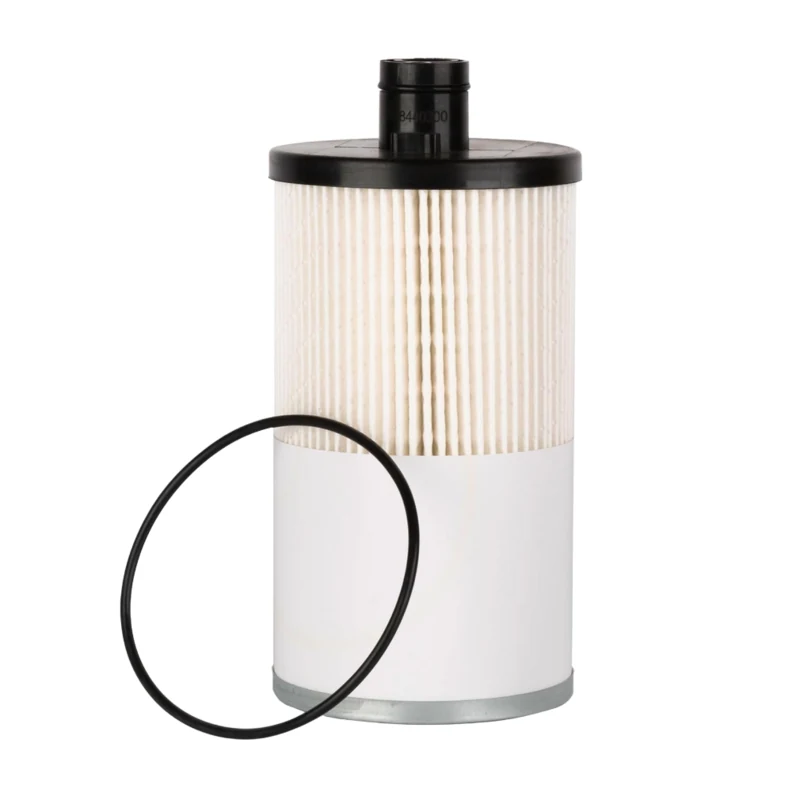
Resin-cured cellulose and multilayer composite media can both be used in diesel fuel filters, but they are selected for different filtration, pressure-drop, contaminant-holding and water-management requirements.
Neither material should be selected by name alone. The correct choice depends on the fuel system, filter construction, operating conditions and validated performance specification.
What Is Resin-Cured Cellulose Filter Media?
Resin-cured cellulose filter media is a cellulose-based material that has been impregnated with resin and thermally cured.
The treatment helps the paper maintain its pleat shape and dimensional stability during element production and service. Its final performance is not determined by the curing process alone. It also depends on:
- Fibre and pore structure
- Media thickness and permeability
- Resin type and content
- Pleat number and pleat depth
- Effective filtration area
- Finished-filter construction
A properly selected cellulose grade can provide a practical and proven solution for many diesel fuel-filter designs.
What Is Multilayer Composite Filter Media?
Multilayer composite media combines two or more media layers or structures in one filtration system.
The layers may perform different functions. Depending on the actual construction, they can be designed to support:
- Staged or gradient particle filtration
- More controlled contaminant distribution
- Higher contaminant-holding capacity
- A specific balance between efficiency and pressure drop
- Structural support
- Fuel-water coalescing or separation
However, the term “composite media” does not automatically mean that a filter separates water. Water management requires a media structure and completed filter specifically designed and tested for that purpose.
Main Differences
| Item | Resin-Cured Cellulose Media | Multilayer Composite Media |
|---|---|---|
| Basic structure | Primarily cellulose-based media with resin treatment | Two or more functional media layers or structures |
| Pleat stability | Improved through resin impregnation and thermal curing | Depends on the materials, supporting layers and bonding method |
| Filtration design | Can meet many established fuel-filtration requirements | Can be engineered for staged or gradient filtration |
| Pressure drop | Depends on media grade, surface area and pleat design | Depends on the permeability and combination of the layers |
| Contaminant capacity | Depends on fibre structure and available filtration area | May distribute contaminant loading across different layers |
| Water management | Available only when the specific media and filter design support it | May include a dedicated coalescing or separation layer |
| Typical selection | Proven spin-on and cartridge constructions that meet the specified requirement | Applications requiring a defined combination of fine filtration, capacity or water management |
| Direct interchangeability | Requires validation | Requires validation |
These are general design tendencies, not guaranteed performance values. Actual performance must be confirmed by the media specification and completed-filter testing.
ISO 19438 evaluates fuel-filter particle-removal characteristics, contaminant capacity and differential pressure under a defined test method. This is why a filter should not be judged only by a general “micron” claim.
Where Is Resin-Cured Cellulose Media Commonly Used?
Depending on the selected grade and filter design, resin-cured cellulose media can be used in:
- Spin-on diesel fuel filters
- Replaceable fuel-filter cartridges
- Diesel pre-filters
- Primary or secondary fuel filters
- Some fuel-water separator elements
- Filters for commercial vehicles, agricultural machinery and construction equipment
This does not mean that every product in these categories uses the same cellulose paper. The media must still match the required efficiency, flow resistance, contaminant capacity and service conditions.
Resin-cured cellulose should not automatically be described as a low-end material. Many established fuel-filter designs use cellulose-based media because it meets the required specification reliably and economically.
Where Is Composite Media Commonly Used?
Composite media is often considered when the filter requires several performance functions to work together.
Typical applications may include:
- Fine diesel fuel-filter elements
- Filters for sensitive diesel injection systems
- Staged or gradient filtration designs
- Products requiring a defined balance of efficiency, capacity and pressure drop
- Fuel-water separators using a validated coalescing or separation layer
- Applications with specific service-life or contaminant-loading requirements
Composite construction alone does not prove that a filter is suitable for a high-pressure common-rail system. Suitability must be confirmed against the filter specification and completed-product test results.
Which Media Should a Buyer Choose?
1. Confirm the product identity
Provide the filter part number, OE reference, product sample, drawing or clear photographs.
2. Confirm the fuel system
Identify the engine, equipment and installation position. A pre-filter and a final filter may have different requirements.
3. Define the required filtration performance
Confirm the required efficiency, test method and contaminant-retention requirement instead of relying only on a nominal micron description.
4. Confirm flow and pressure-drop limits
The filter must provide the required fuel flow without creating unacceptable restriction.
5. Confirm water-management requirements
State whether the filter must remove free water, support coalescing or meet a specified water-separation test.
6. Confirm the complete filter construction
Media performance also depends on dimensions, pleat geometry, centre tube, end caps, adhesive, seals and housing structure.
7. Validate before bulk production
When the media or construction changes, approve the specification and finished-filter sample before placing a bulk order.
Questions to Include in a Fuel-Filter RFQ
To identify the correct filter and media construction, send:
- Part number or OE number
- Vehicle, engine or equipment model
- Product photograph, sample or drawing
- Overall dimensions and sealing structure
- Required filtration or test specification
- Fuel-water separation requirement
- Expected order quantity
- Packing and marking requirements
Frequently Asked Questions
Is composite fuel-filter media always better than cellulose?
No. Composite media provides additional design options, but suitability depends on the complete filter specification and validated performance. A cellulose-based medium may be the correct choice when it meets the required efficiency, pressure drop, capacity and durability.
Can resin-cured cellulose be used in diesel fuel filters?
Yes. It is used in many proven diesel fuel-filter constructions when the selected grade meets the required filtration, flow and durability specifications.
Does composite media always separate water?
No. Water separation requires a media and filter structure designed and tested for that function. The word “composite” alone does not demonstrate water-separation performance.
Can cellulose and composite media be interchanged directly?
Not safely without validation. Changing the media can affect efficiency, pressure drop, contaminant capacity, pleat stability and water-management performance.
Conclusion
Resin-cured cellulose remains a practical and proven choice for many diesel fuel-filter constructions. Composite media is useful when the application requires a defined combination of staged filtration, contaminant capacity or water management.
The correct decision should be based on the completed filter specification and verified performance—not on the media name alone.
Need help matching a fuel filter by part number, OE reference, dimensions or sample? Send the available information to Jinguan for product identification and quotation.